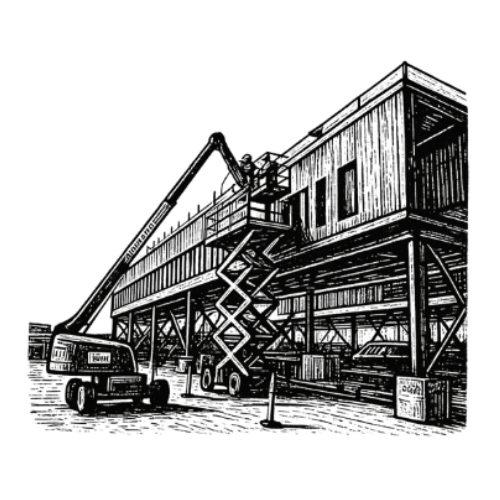
A clean paint job doesn't lift people 80 feet in the air safely. Maintenance, structural condition, and function testing matter far more than appearance. Boom lifts live hard lives — job sites, rough terrain, transport damage, overloaded baskets. The machines that come out of that in good shape are the ones worth buying. This guide covers the six things that actually matter when evaluating a used boom lift, plus the inspection sticker most buyers never think to check.
01
Structural Damage & Weld Repairs
This is the most important thing on the list. Boom lifts take impacts — from job sites, overloaded baskets, rough terrain, and transport. Cosmetic scratches are normal. Structural repairs are not.
Walk every inch of the boom and chassis before you look at anything else. You're inspecting for bends, twists, or ripples in boom sections; fresh paint that might be hiding recent repairs; non-factory welds on the boom, turntable, or chassis; cracks around pivot points; and any damage to the basket mounting area.
Context matters here. A repaired guardrail is not a big deal. A welded boom section absolutely is — and if the repair history isn't fully documented, walk away.
Walk Away Rule
If the machine has structural weld repairs in major load-bearing areas and the seller can't produce documentation of who did the work and why, that's not a negotiating point — that's a hard stop.
02
Hours vs. Maintenance History
Hours alone don't tell the story. A well-maintained 5,000-hour boom lift can easily outperform a neglected 2,000-hour unit. The number on the meter is the starting point for a conversation, not the conclusion.
Ask for service records, annual inspection documentation, hydraulic service history, engine maintenance logs, and battery replacement history on electric units. A seller who can't produce any of that isn't necessarily hiding something — but missing maintenance history usually means deferred maintenance, and deferred maintenance means you're buying someone else's problems.
Field Rule
Service history is often more important than hour meter readings. A well-documented machine at high hours beats an undocumented machine at low hours almost every time.
03
Hydraulic Leaks & Cylinder Condition
Boom lifts are hydraulic machines first and foremost. When hydraulics go wrong, repairs get expensive fast. This is an area where a few minutes of careful inspection can save you thousands.
Check hydraulic hoses for dry rot or cracking. Inspect cylinder rods for pitting or scoring — a pitted rod will destroy seals under load. Look under the turntable for leaks and check for seepage around lift cylinders. Then operate the machine and watch for jerky or inconsistent boom movement, which often indicates hydraulic wear or a failing seal somewhere in the system.
A smooth machine is usually a healthy machine. A boom that chatters, surges, or drifts under load is telling you something.
04
Function Test Every Movement
Never buy a boom lift without fully operating it. This is non-negotiable. A machine can look excellent and still have electrical or control system issues hiding underneath.
Test every function from both the ground controls and the platform controls. That means drive function, steering, swing rotation, telescope extension, platform rotation, and the emergency lowering system. Don't skip the last one — it's a safety system and it needs to work.
Also verify that tilt alarms and limit switches are functioning. These aren't formalities — they're the systems that keep someone from getting hurt when the machine is pushed toward its limits. A unit with disabled or bypassed safety systems should be priced to account for the cost of restoring them.
Non-Negotiable
If the seller won't let you fully operate the machine from both control stations, that's your answer. A machine that runs fine has no reason to be kept off the lot.
05
Tires, Axles & Undercarriage Wear
Tires tell you a lot about how a machine was treated. On boom lifts — especially rough terrain models — check foam-filled tires for separation from the rim, deep chunking or sidewall damage, and uneven wear patterns that suggest alignment or axle issues.
While you're down there, check for leaking axle hubs and loose steering components. On rough terrain booms in particular, axle and steer component repairs can become surprisingly expensive, and the wear is easy to spot if you know to look for it.
One practical point worth keeping in mind: tire replacement alone on large boom lifts can run several thousand dollars. If the tires are at end of life, factor that into the price conversation before you agree to anything.
06
Verify Model Support & Parts Availability
This one gets overlooked constantly, especially on older machines. Some boom lifts still run fine but have obsolete control boards, discontinued engine components, or limited OEM support — meaning the next time something goes wrong, you're hunting for parts with long lead times or paying a premium for the few that still exist.
Before you commit, check whether the manufacturer still supports the model, whether aftermarket parts are available, and whether there's local dealer support in your area. This matters especially with older machines from brands or product lines that changed ownership over the years.
A running machine with no parts support is a countdown clock. Know what you're buying.
Pre-Purchase Inspection Checklist
Pull this up on your phone at the lot. Check everything before you commit.
Structural Condition
Maintenance History
Hydraulics
Function Test
Tires & Undercarriage
Bonus: ANSI Inspection Sticker
Bonus
Check the ANSI Inspection Sticker
Most professionally maintained boom lifts will have evidence of current annual inspections — not just a sticker, but documentation behind it. A missing inspection history can indicate poor fleet management, long periods sitting unused, or deferred repairs that were never addressed.
It's a small thing to check and it tells you a lot about how the machine was managed. A fleet that kept up with annual inspections generally kept up with everything else too.
07
What to Expect to Pay
Used boom lift pricing varies widely based on reach, fuel type, age, hours, and condition. Straight-mast electric boom lifts in the 40–45 ft range from 2015–2020 with reasonable hours typically fall between $15,000–$30,000 in solid working condition. Articulating models and diesel rough terrain units at larger heights command considerably more.
Structural issues, missing maintenance history, or end-of-life tires should move the price meaningfully downward — and if a seller isn't willing to budge given documented problems, that's a negotiating point worth pressing.
As with most used equipment, the machines priced at the low end of the market are priced there for a reason. The goal is to find the unit that's been well-maintained but priced fairly — not the cheapest thing on the lot.